On this page · 9 sections
Quick answer
Not paid yet? Hang up. The FTC says only scammers will tell you to buy a gift card and give them the numbers off the back. Already paid? Contact the gift card company right away, using the number on the back of the card or the company's official website. Tell them a scammer got the card number and PIN, and ask for your money back. Keep the card and the receipt. Then report it at ReportFraud.ftc.gov, and never pay anyone who offers to recover the money for a fee.
Per the FTC, only scammers tell you to buy a gift card and hand over the numbers off the back. If the codes are out, contact the issuer immediately through the number on the card or its official site, state that the card number and PIN went to a scammer, and request a refund; Apple and Google can freeze funds still on the card, the FTC says. Keep the card and receipt for the claim, report at ReportFraud.ftc.gov (and to local police for Google Play cards, per Google), and ignore paid 'recovery' offers.
Someone on the phone, in a text or online told you to pay them with gift cards. Maybe you're in the store right now, or maybe you already read them the numbers. Either way, here's what to do, in order.
These steps are for gift cards bought in the U.S. Bought them with a company card, or did the request come to your work email or phone? Tell your employer's IT or security team too. Card companies' help pages and report forms change, and the labels you see may vary by card and by device; the steps below follow the pages of the FTC and of each card company named here as of Oct 23, 2026.
Easy Mode: what to do, easiest step first
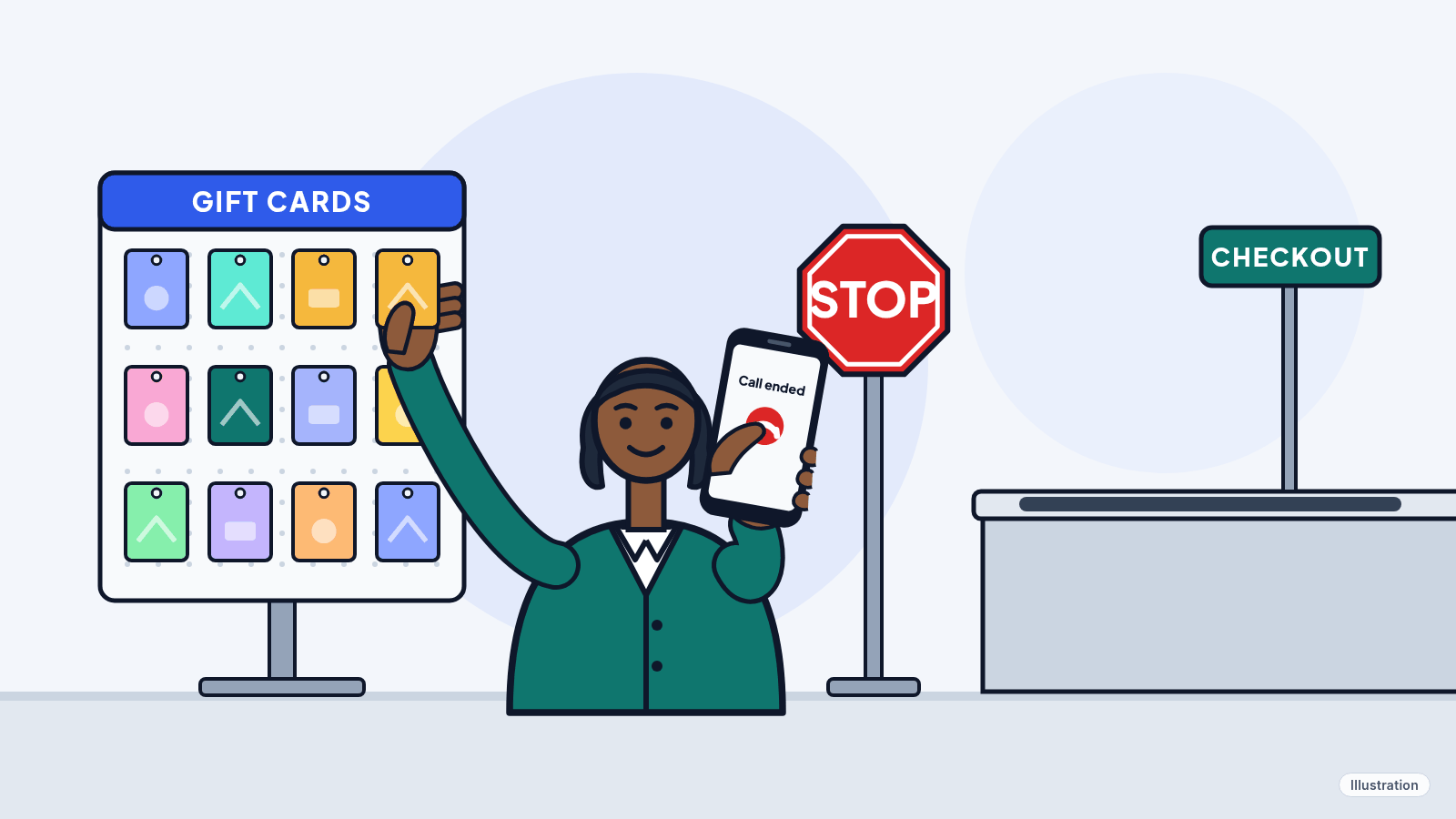
1. Haven't paid yet? Stop. It's a scam
The FTC puts it plainly: "Only scammers will tell you to buy a gift card, like a Google Play or Apple Card, and give them the numbers off the back of the card. No matter what they say, that's a scam." It adds that no real business or government agency will ever tell you to buy a gift card to pay them.
The red flags the FTC lists:
- They rush you. They say to pay right away or something terrible will happen. The FTC's advice: slow down and don't pay.
- They tell you which card to buy, and where. They may name a brand, send you to a particular store, tell you to buy cards at several stores, or stay on the phone while you shop. If that happens, the FTC says to hang up.
- They ask for the card number and PIN. Those numbers let a scammer take the money on the card, even while the card is still in your hand. Don't read them out, and don't send a photo of the card.
The stories vary. The FTC names callers who claim to be from the government (such as the IRS, the Social Security Administration or the FTC), tech support, a friend or relative in an emergency, a prize, the utility company, a romance, or someone who sends you a check for more than you expected. The FTC warns that a scammer using voice cloning "may even sound just like your loved one." Target and Walmart both say that if a caller claims a loved one is in trouble, hang up and contact that person directly. Not sure what you're dealing with? Our is this a scam guide covers the warning signs.
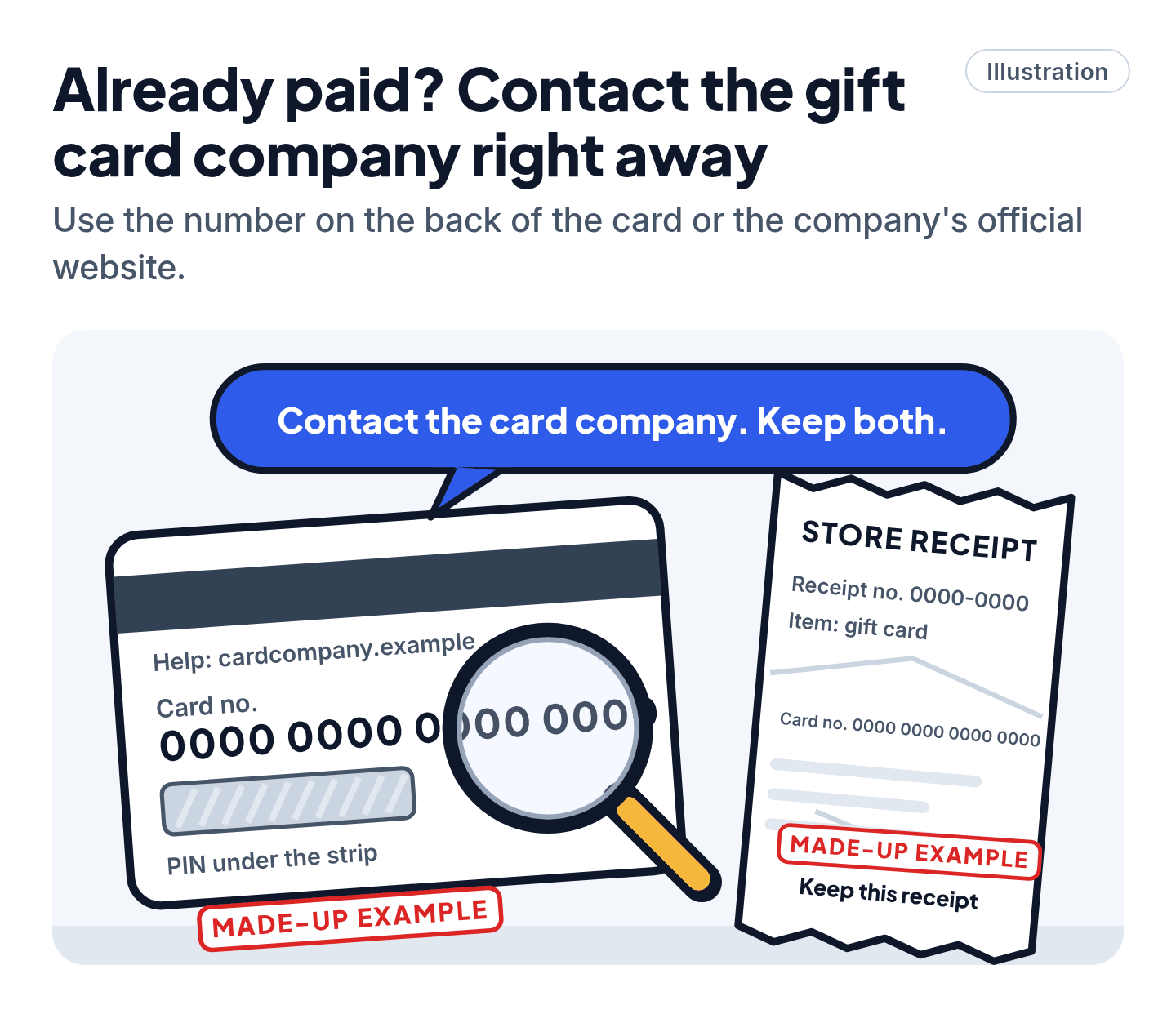
2. Already paid? Contact the gift card company right away
The FTC says to report it to the gift card company right away, no matter how long ago the scam happened.
- Find the company's contact details. The FTC says to use the number on the back of the card. Our read: you can also reach the company through its official website; type the address in yourself, rather than calling a number from a search ad or the scammer's message.
- Say what happened. In the FTC's words, tell them "that a scammer tricked you into giving them the card number and PIN."
- Ask for your money back. The FTC says some companies might give your money back, and it's worth asking. It also warns that if you paid a scammer, your money might already be gone.
Not sure which company to contact? The FTC's gift card page has a "How To Contact Gift Card Companies" list, including Amazon, American Express, Apple, Best Buy, eBay, Google Play, MoneyPak, ReloadIt, Sephora, Steam, Target, Vanilla, Visa and Walmart. Card not on the list? The FTC says to look for the company's contact information on the card itself, or research online how to reach the card issuer. Our read: use the number on the back of the card or the issuer's official website, typed in yourself, and never call a number from a search ad, a pop-up or the scammer's message.
3. Keep the card and the receipt
Hold on to the card, and the receipt if you have it; the FTC says you may need them to follow up on your claim. The FTC also says to always keep a copy of the card and the store receipt, and suggests taking a photo of both with your phone.
4. Report it
- FTC: tell the FTC at ReportFraud.ftc.gov. The FTC says every report makes a difference. If you can't find the card company's contact details, or the issuer won't talk to you, the FTC says to report that to the FTC too.
- Police: for Google Play gift cards, Google says to report the scam to your local police department. Target says that if a stranger calls asking you to buy gift cards, hang up and report the call to local law enforcement.
- Your state: Walmart says that if you suspect you've been a victim of fraud, contact the FTC or the Consumer Fraud Division of your state attorney general.
Did you also give out a password, bank details or remote access to your computer? Follow our clicked a scam link guide too.
5. Watch out for "we'll get your money back" offers
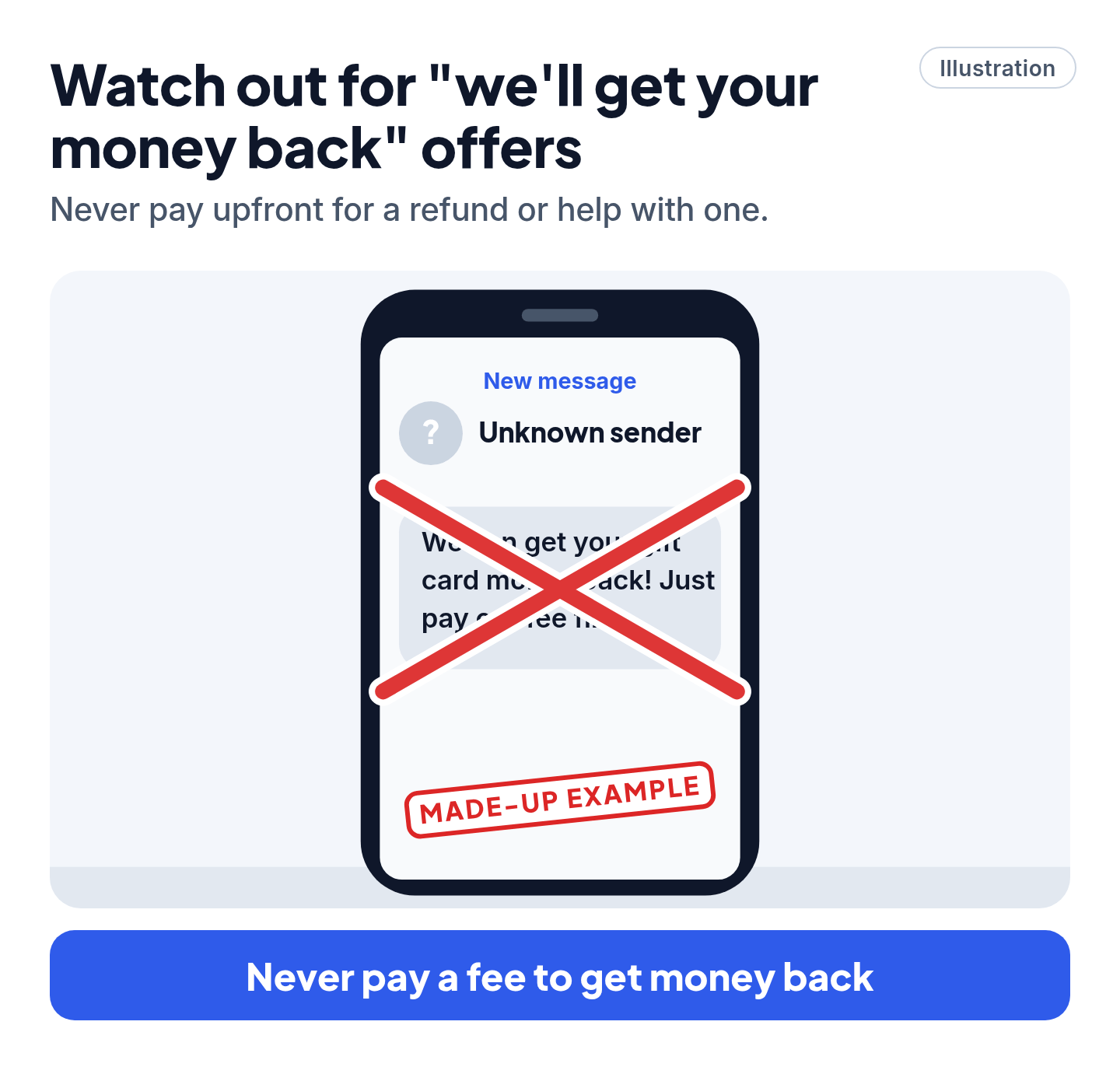
The FTC warns that refund and recovery scams target people who have already lost money. The caller may claim to be from a government agency, a consumer group, a law firm or even the company that took your money, and then ask for an upfront fee or your bank details. The FTC: "Government agencies and legitimate organizations will never ask for money to help you get a refund." Never pay upfront for a refund or help with one. If you want to check a caller's story, look up the agency's or company's contact details yourself. Lost money to one of these offers? The FTC says to report it at ReportFraud.ftc.gov and to your state attorney general.
What the card companies' own pages say
- Apple: Apple's page says Apple gift cards can be used only to buy products and services from Apple, so they can't pay bills or government fees such as taxes or immigration fees. If someone asks you to use one for something Apple doesn't sell, Apple says you might be the target of a scam. If you think you're a victim, Apple says to contact Apple Support online. The FTC adds: ask whether the money is still on the card; if it is, Apple can freeze it.
- Google Play: Google's page also covers specialty gift cards bought in the Google Play app, and says never to share the code on the back of a card or inside a digital gift card's redemption link. Google says Play gift cards can only be used for purchases on Google Play, and never "to pay for taxes, bail money, or anything outside Google Play." If you were scammed, Google says to report it to your local police, and you can also report it to the FTC. Then report it to Google through its help page (there's a form if you don't have a Google Account); the report must come from the person who was scammed. For a lost or stolen card, Google says it can't issue a new gift card, because Play gift cards can't be resold, exchanged or transferred for value; Google also says Play gift cards are non-refundable unless the law requires it. The FTC says that if the money is still on the card, Google can freeze it.
- Target: Target says not to buy, sell or check the balance of a gift card outside Target.com, and to check balances only on Target's site. Don't buy a card if its packaging looks altered; ask a team member instead. Target's signs of a tampered card include torn or cut edges, a lot of glue residue, and tears or stretching on holograms or stickers.
- Walmart: Walmart says to treat gift cards the same as cash and never give the numbers on the back, or a picture of the card, to someone you don't know. It adds: "No legitimate government entity, including the IRS, Treasury Department, FBI or local police department, will accept any form of gift cards as payment."
- Visa gift cards: Visa's page says to report a lost or stolen card immediately to the card issuer, using the number on the issuer's website or in the card's paperwork, and that some issuers will replace a card only if it was registered. Our read: if a scammer got the numbers from your Visa gift card, contact that issuer the same way and tell them it was a scam.
Scam warning: the second call
Scam warning
- "We can get your money back, for a fee." Recovery scammers go after people who have just lost money. The FTC says no government agency or legitimate organization charges you to help get a refund.
- "Move your money to keep it safe." The FTC says it will never threaten you or tell you to transfer your money to "protect it." Our read: treat that request as a scam, whoever the caller says they are.
- "Just read me the numbers to check the balance." Our read: no one you don't know needs the numbers on the back of your card. Check a balance only through the card company's official website or the number on the card.
Still stuck? Find your situation
| What you see | What it means | What to do |
|---|---|---|
| Someone wants you to buy gift cards and give them the numbers | The FTC says only scammers do this | Hang up and don't buy (step 1) |
| You're at the store and the caller is still on the line | A scammer is guiding you | Hang up, the FTC says (step 1) |
| You already read out the numbers | The FTC says those numbers let the scammer get the money, even if you still have the card | Contact the card company right away (step 2) |
| Apple or Google Play card | Money still on it may be frozen, the FTC says | Contact Apple Support online, or report it to Google (step 2 and the company list) |
| Card company won't help, or you can't reach it | Report it anyway | ReportFraud.ftc.gov (step 4) |
| Someone offers to recover the money for a fee | A recovery scam | Don't pay; report it (step 5) |
Pro Mode
Pro Mode Pro Mode: helping someone else, and buying gift cards safely
Helping a parent or friend. Google says the report to Google must come from the person who was scammed. Our read: sit with them while they file it, rather than filing it for them. Our read: write down which cards were bought, at which stores, when, and when the codes were shared, and keep the cards, the receipts and the scammer's texts or call log in one place before anyone calls the card company.
Buying gift cards as gifts. The FTC says to stick to stores you know and trust and to avoid online auction sites, where cards may be fake or stolen. Before you buy, check that the protective stickers are on the card and look untouched, and that the PIN on the back isn't showing. If something's wrong, pick another card and show the tampered one to a cashier or manager. Then take a photo of the card and the receipt.
You've got this
Our read: scammers count on panic and shame. Being targeted isn't your fault. Hang up, call the card company yourself, keep the card and the receipt, and report it. Anyone who then offers to get your money back for a fee is another scammer.
Sources
The 9 pages we checked
- FTC Consumer Advice: Avoiding and Reporting Gift Card Scams
- FTC Consumer Advice: What To Do if You Were Scammed
- FTC Consumer Advice: Refund and Recovery Scams
- FTC: ReportFraud.ftc.gov
- Apple Support: About gift card scams
- Google Play Help: What to do if you're a victim of a Google Play gift card scam
- Target: Gift Card Fraud Prevention
- Walmart: Fraud Alerts
- Visa: Check Visa Gift Card Balance
More free guides are on the way.