
On this page · 8 sections
Quick answer
Watch for the FTC's 4 warning signs: someone pretends to be a company or person you trust, there's a problem or a prize, they pressure you, and they want a gift card, crypto or a wire. Spot one? Stop and check with someone you trust.
Impersonation, a problem or prize, pressure and an unusual payment rail are the FTC's four signs of a scam. Verify through a channel you look up yourself, never the one in the message; caller ID can be spoofed. Report to ReportFraud.ftc.gov and ic3.gov. Over-60s: DOJ National Elder Fraud Hotline. Sextortion of a minor: tips.fbi.gov and NCMEC's CyberTipline.
Scammers target the whole family: kids in games, teens in DMs, parents with fake bank alerts and grandparents with fake emergencies. The good news: the FTC lists four signs that something is a scam. Learn them together once and everyone can spot them.
Easy Mode: the 4 warning signs, plus 5 common scams to talk about
Takes 10 minutes to read together. Free, on any device.
1. Learn the 4 warning signs
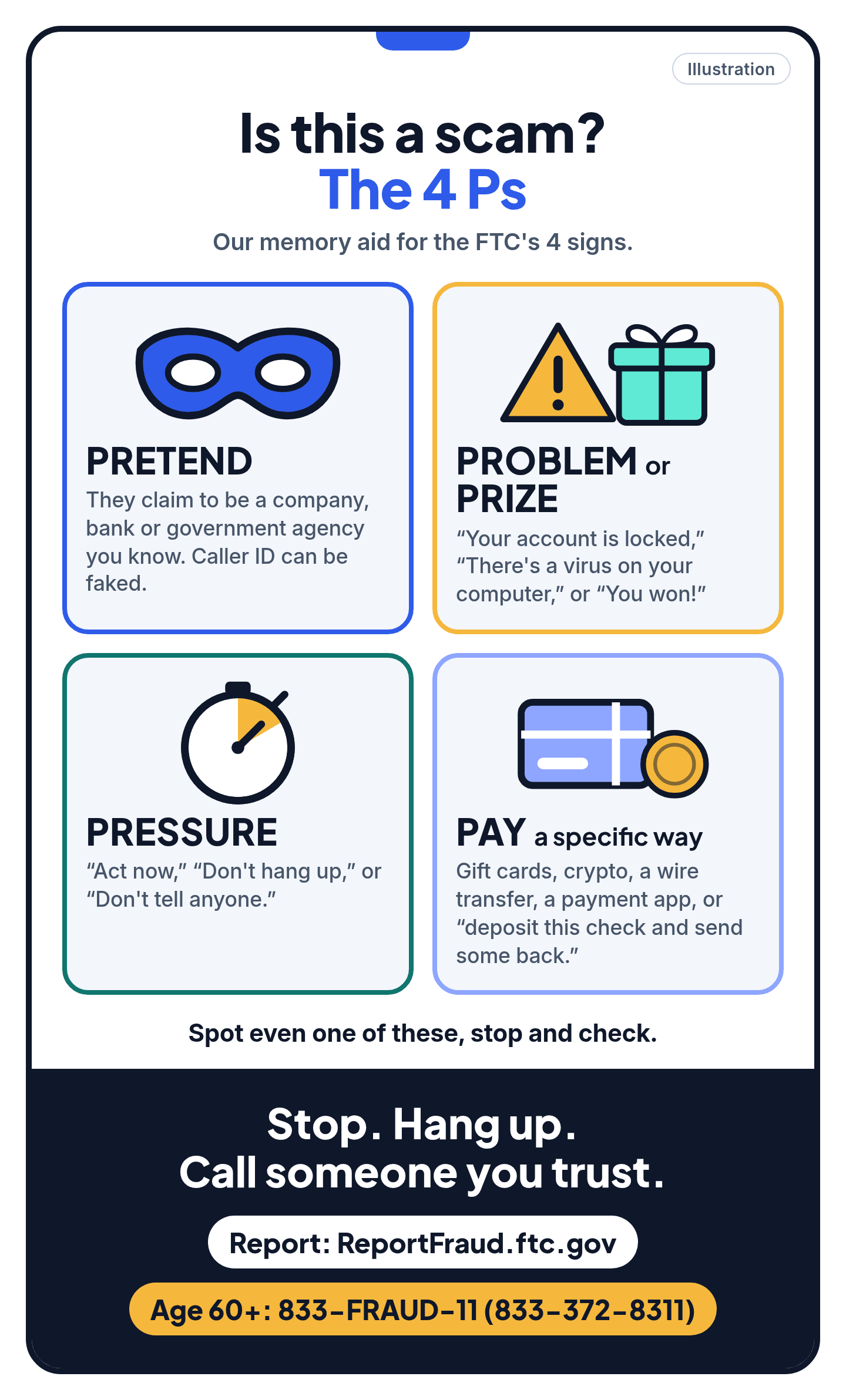
The FTC lists four signs that it's a scam. We call them the 4 Ps to make them easy to remember. (That's our memory aid, not an FTC term.)
- Pretend: they claim to be a company, bank or government agency you know. Caller ID can be faked.
- Problem or Prize: "Your account is locked," "There's a virus on your computer," or "You won!"
- Pressure: "Act now," "Don't hang up," or "Don't tell anyone."
- Pay a specific way: gift cards, crypto, a wire transfer, a payment app, or "deposit this check and send some back."
Our rule of thumb: spot even one of these, stop and check. Spot two, treat it as a scam.
Cheat code
Make a "you won't be in trouble" deal. Tell your kids (and your parents): "If anything scares you or asks for money, talk to me first. You won't be in trouble." Scammers count on embarrassment and secrecy.
2. "Free" game money is a trap
Offers of free Robux, V-Bucks or skins are a favorite trick. Roblox says any offer of free Robux is a scam meant to steal your password or account.
- Never type your game password anywhere except the game's own login page.
- Never share gift card codes with another player.
- Turn on purchase approval so you see every purchase first:
- iPhone or iPad (parent's device): Settings > Family > your child's name > Apps & Websites > Restrictions > Ask to Buy, then turn on Require Purchase Approval.
- Android: in the Family Link app, choose your child, then Controls > Google Play > Require approval for.
3. "You won!" Real prizes are free
The FTC's rule is simple: if you have to pay to get a prize, it's a scam. That includes "taxes," "shipping" or "processing fees." Ask your kids: "Did you even enter a contest?"
4. Scam texts, emails and calls: don't click, check
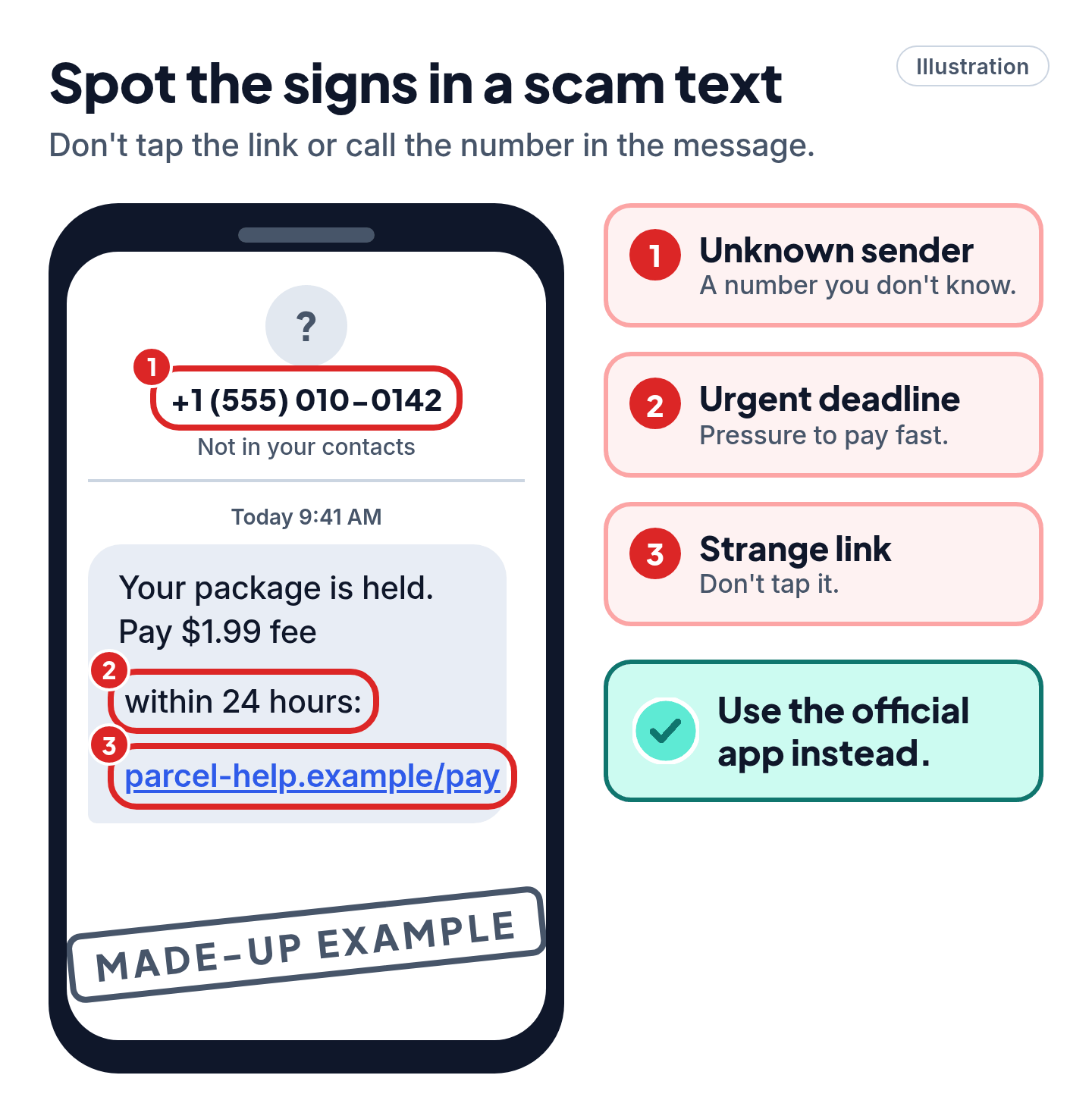
- Don't tap the link or call the number in the message. Look up the number yourself, or use the official app.
- Never share a verification code or password with anyone who contacted you.
- Report scam texts: forward them to 7726 (SPAM), and use "Report junk" or "Report spam" in your messaging app.
- "FTC" caller wants you to move money, withdraw cash or buy gold? The FTC says that's a scam.
5. "Grandma, it's me. I'm in trouble."
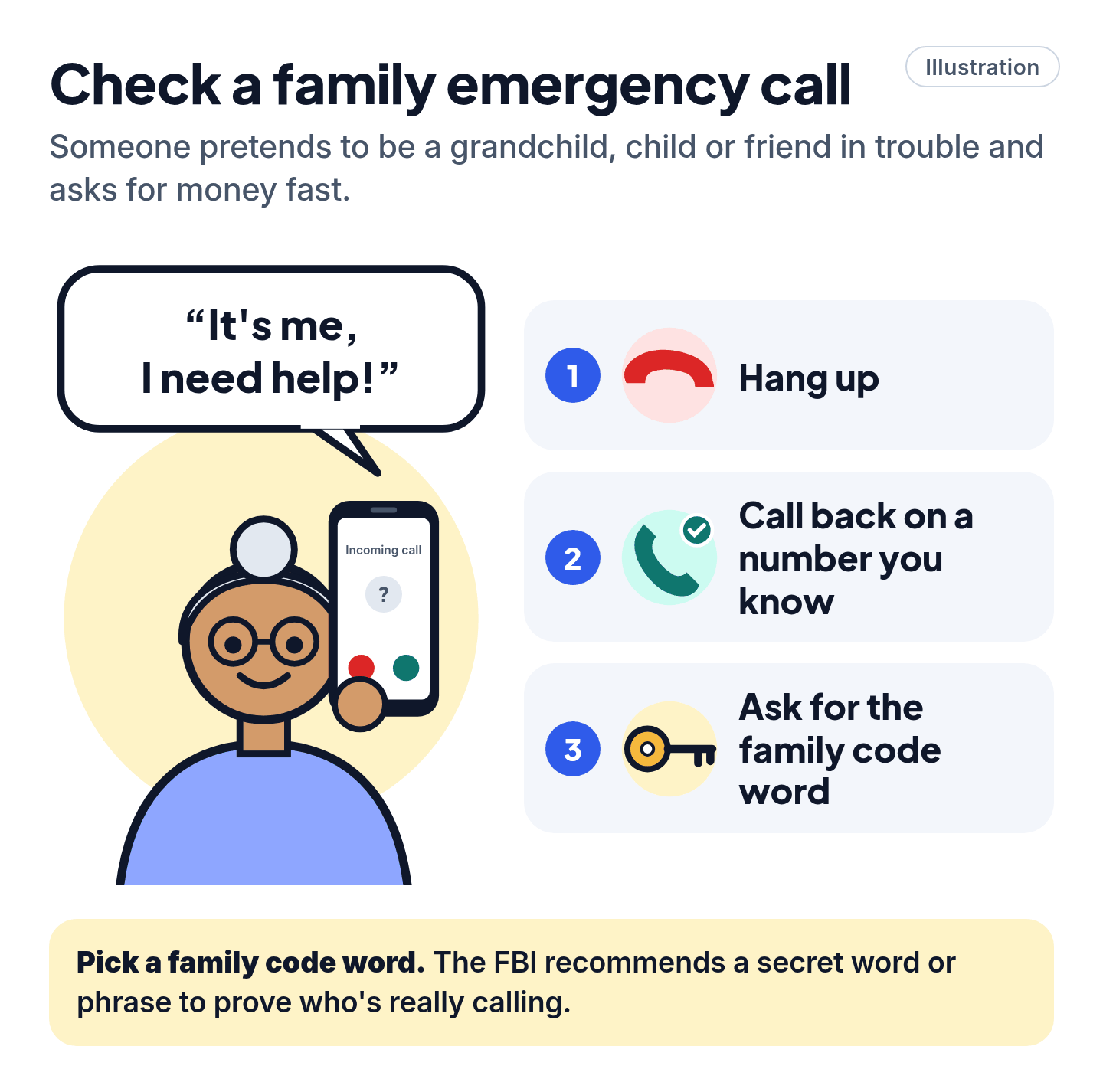
Someone pretends to be a grandchild, child or friend in trouble and asks for money fast. The FTC warns scammers can clone a voice from a short online clip.
- Hang up and call back on a number you know is real.
- Call another relative to check, even if the caller begged for secrecy.
- Pick a family code word. The FBI recommends a secret word or phrase to prove who's really calling.
6. Sextortion: the one to talk about with teens
A stranger, often pretending to be a teen, gets a young person to share a private photo, then demands money or more photos. In money-driven sextortion, the FBI says victims are typically boys aged 14 to 17, but any child can be targeted.
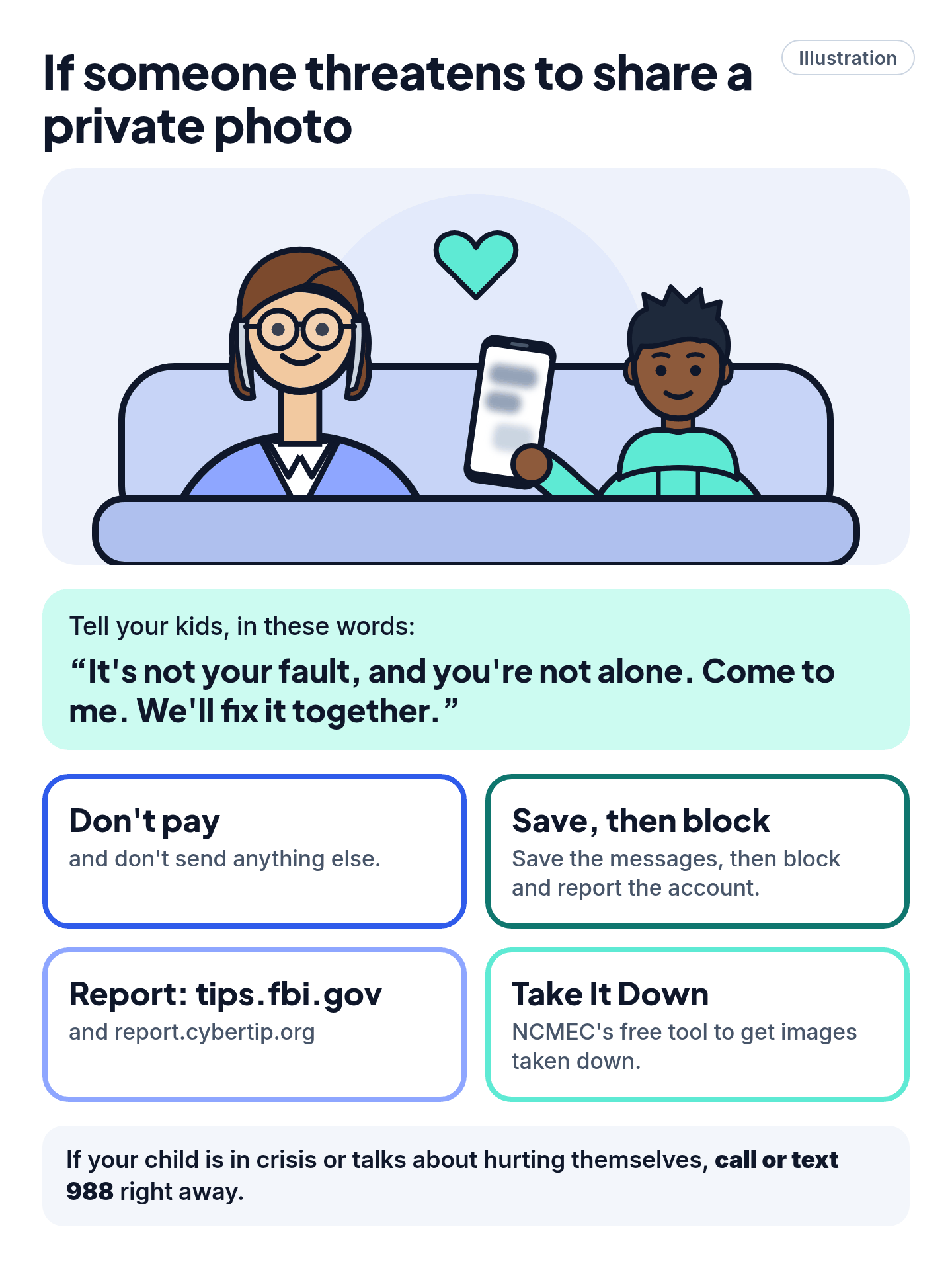
Tell your kids, in these words: "It's not your fault, and you're not alone. Come to me. We'll fix it together."
- Don't pay and don't send anything else. The FBI says going along with it rarely stops the threats.
- Save the messages, then block and report the account.
- Report it at tips.fbi.gov and report.cybertip.org.
- To get images taken down, use NCMEC's free Take It Down tool.
If your child is in crisis or talks about hurting themselves, call or text 988 right away.
Watch out for the second scam
Scam warning
- "We can get your money back, for a fee." Refund and recovery scammers target people who already lost money. Never pay upfront for help getting a refund. Reporting to ReportFraud.ftc.gov and ic3.gov is free.
- Don't pay anyone to remove images. Take It Down is free.
- Never give remote access to someone who contacted you. Fake "tech support" often starts with a printer problem or a slow computer.
Still stuck? Already paid or clicked
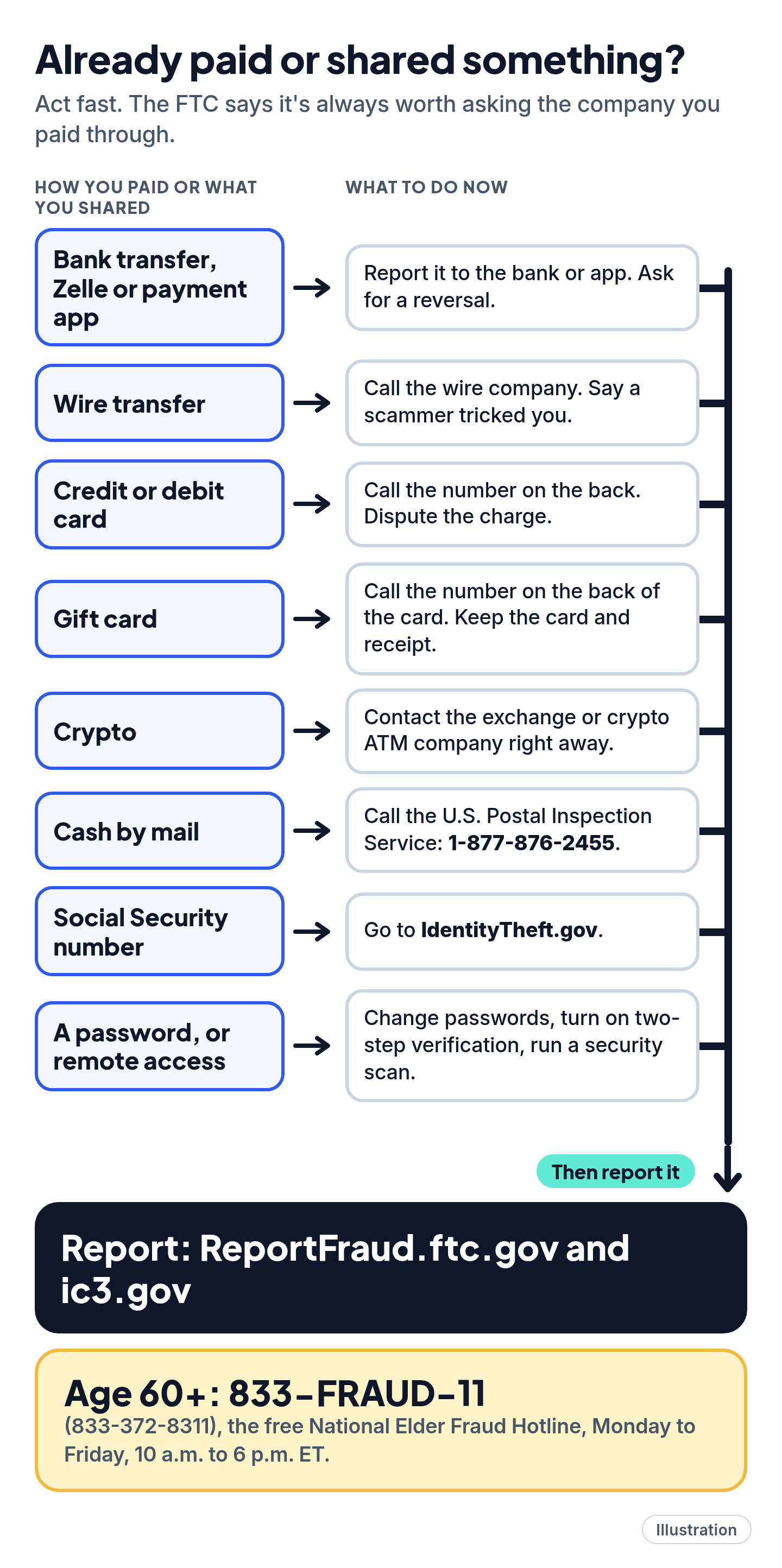
Act fast. The FTC says it's always worth asking the company you paid through.
| How you paid or what you shared | What to do now |
|---|---|
| Bank transfer, Zelle or payment app | Report it to the bank or app. Ask for a reversal. |
| Wire transfer | Call the wire company. Say a scammer tricked you. |
| Credit or debit card | Call the number on the back. Dispute the charge. |
| Gift card | Call the number on the back of the card. Keep the card and receipt. |
| Crypto | Contact the exchange or crypto ATM company right away. |
| Cash by mail | Call the U.S. Postal Inspection Service: 1-877-876-2455. |
| Social Security number | Go to IdentityTheft.gov. |
| A password, or remote access | Change passwords, turn on two-step verification, run a security scan. |
Then report it at ReportFraud.ftc.gov and ic3.gov. Age 60 or older? Call the free National Elder Fraud Hotline at 833-FRAUD-11 (833-372-8311), Monday to Friday, 10 a.m. to 6 p.m. ET. Dial it yourself, because scammers pretend to be hotline staff.
Pro Mode
Pro Mode Pro Mode: the data, reporting details and extra settings
The numbers (FBI and IC3). The FBI's 2025 Internet Crime Report, released April 6, 2026, logged 1,008,597 complaints and nearly $21 billion in losses. Americans 60 and older filed 201,266 complaints (up 37% from 2024) and reported about $7.7 billion in losses (up 59%). Crypto complaints (181,565) had the highest losses, more than $11 billion. AI-related complaints (22,364) cost nearly $893 million, including voice clones and fake videos of loved ones.
Sextortion data. The FBI's IC3 says it received more than 75,000 sextortion submissions in 2025 and referred more than 5,700 involving minors to NCMEC. You can also report by phone at 1-800-CALL-FBI. The FBI links this crime to teen suicides, which is why the "you're not in trouble" message matters.
Before you report, write it down. The FBI asks for the scammer's name or company, how and when they contacted you, how you paid, where the money went, and a description of what happened. Take screenshots of usernames and chats before you block or report.
Gift cards. Call the issuer the moment you realize. Tell them a scammer got the card number and PIN.
Adults' images. NCMEC's tools are for images taken when someone was under 18. For adults (18 or older when the image was taken), see StopNCII.org.
Voice cloning. The FBI suggests limiting public videos and voice clips, making social accounts private, and listening for odd tone or word choice. Don't trust caller ID or a familiar voice on its own.
Game account hygiene. Turn on two-step verification wherever the game offers it, keep payment cards off kids' accounts, and use chat restrictions. The FTC's kids and video games guide covers purchases, chat, time limits and location sharing.
Text reporting. Forwarding to 7726 helps your phone company block similar texts. The FTC can't accept forwarded texts, so paste the text into your ReportFraud report.
You've got this
You don't need to know every scam. Teach the 4 signs and make sure everyone knows they can always come to you.
Sources
The 24 pages we checked
- FTC: How to avoid a scam (the four signs)
- FTC: What to do if you were scammed
- FTC: Refund and recovery scams
- FTC: Avoiding and reporting gift card scams
- FTC: Fake prize, sweepstakes and lottery scams
- FTC: How to recognize and report spam text messages
- FTC: Scammers use fake emergencies to steal your money
- FTC: Kids and video games
- FTC: ReportFraud.ftc.gov FAQ (forwarded texts)
- FBI: Cryptocurrency and AI scams bilk Americans of billions (Apr 6, 2026)
- FBI IC3: 2025 Internet Crime Report
- FBI: The financially motivated sextortion threat
- FBI: Sextortion: a growing threat targeting minors (Jan 16, 2024)
- FBI IC3: Criminals use generative AI to facilitate financial fraud (family code word, voice cloning)
- U.S. Department of Justice, Office for Victims of Crime: National Elder Fraud Hotline (includes its impersonation-scam alert)
- NCMEC: Sextortion, CyberTipline and Take It Down
- FCC: Stop unwanted robocalls and texts
- Apple Support: Approve what your child can purchase with Ask to Buy
- Google Play Help: Purchase approvals on Google Play
- Roblox Support: Free Robux or subscription generators
- 988 Suicide & Crisis Lifeline: 988lifeline.org
- StopNCII.org: StopNCII (for images taken at 18 or older)
More free guides are on the way.